
TEMPORARY PAYMENT-REDUCTION STRATEGIES
Temporary Rate Buydowns
Use eligible seller, builder, lender, or other permitted funds to temporarily reduce the effective interest rate and scheduled principal and interest payment during the early years of a mortgage.
Lower scheduled payments during the introductory period
May be funded by eligible seller, builder, or lender contributions
The full note rate remains fixed from closing
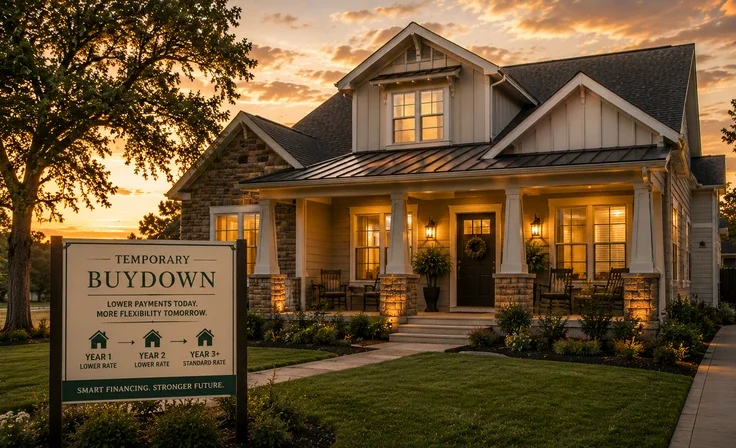
Program eligibility, contribution limits, qualifying payment, funding source, and lender requirements apply.
LOWER PAYMENTS TODAY · GREATER FLEXIBILITY TOMORROW
A Temporary Buydown Strategy Built Around the First Years of Homeownership
A temporary rate buydown uses funds deposited at closing to subsidize part of the scheduled principal and interest payment during an introductory period. The borrower’s note rate does not change; the subsidy temporarily offsets the difference between the reduced payment and the full note-rate payment.
Golden Oak Mortgage Group helps buyers compare temporary buydowns with permanent discount points, lender credits, price reductions, and traditional fixed-rate financing before deciding how available concessions should be used.
WHEN A TEMPORARY BUYDOWN MAY FIT
Could a Temporary Rate Buydown Support Your Purchase?
Lower Initial Payments
Reduce the scheduled principal and interest payment during the applicable introductory period.
Ease Into Homeownership
Create additional monthly flexibility during the first one, two, or three years after closing.
Use Eligible Concessions
Apply permitted seller, builder, lender, or other approved funds toward the required subsidy account.
Known Future Payments
Review the payment schedule before closing so the transition to the full note-rate payment is clear.
Multiple Loan Programs
Temporary buydowns may be available with eligible conventional, FHA, VA, or jumbo financing.
Compare the Alternatives
Evaluate the buydown against points, lender credits, price reductions, and other uses of available concessions.
COMPARE THE USE OF CONTRIBUTIONS
A Lower Early Payment Is Only One Part of the Decision
The same seller or builder contribution may potentially be used for other eligible costs. Compare the temporary subsidy with permanent points, closing-cost credits, prepaid items, or a negotiated price adjustment.
Confirm that the long-term payment is comfortable after the temporary subsidy ends.
Calculate the total subsidy needed to fund each month of reduced principal and interest payments.
Verify who will fund the buydown and whether the contribution is permitted by the loan program.
Determine which payment the lender will use for underwriting and ability-to-repay analysis.
Compare the temporary buydown with discount points, lender credits, closing costs, and price negotiations.
MODEL THE PAYMENT SCHEDULE
Helpful Temporary Buydown Calculators
Estimate the subsidy cost, reduced introductory payments, full note-rate payment, and competing uses of seller or builder concessions.
COMMON QUESTIONS
Temporary Rate Buydown FAQs
What is a temporary rate buydown?
A temporary rate buydown uses funds deposited at closing to subsidize part of the borrower’s scheduled principal and interest payment for a limited introductory period.
Does the mortgage note rate actually change?
No. The note rate is established at closing. The subsidy temporarily offsets the difference between the reduced introductory payment and the payment calculated at the full note rate.
What is a 2-1 buydown?
A 2-1 buydown generally uses an effective rate two percentage points below the note rate in year one and one percentage point below the note rate in year two.
What is a 1-0 buydown?
A 1-0 buydown generally uses an effective rate one percentage point below the note rate during the first year before the scheduled payment moves to the full note-rate amount.
What is a 3-2-1 buydown?
A 3-2-1 buydown generally reduces the effective rate by three percentage points in year one, two points in year two, and one point in year three.
Who may fund a temporary buydown?
Depending on the loan program and lender, eligible funds may come from a seller, builder, lender, borrower, or another approved source.
How is the buydown cost calculated?
The cost is generally the sum of the monthly differences between the full note-rate principal and interest payment and each reduced introductory payment.
Will the payment increase after the buydown period?
Yes. The scheduled principal and interest payment steps up according to the disclosed schedule until it reaches the full payment calculated at the note rate.
Does a temporary buydown help a borrower qualify?
Qualification depends on the loan program and lender. Many programs require underwriting using the full note-rate payment rather than the reduced introductory payment.
Which loan programs may permit temporary buydowns?
Eligible conventional, FHA, VA, jumbo, and other lender programs may permit temporary buydowns, subject to program and lender guidelines.
Can a temporary buydown be used on new construction?
Yes, when permitted. Builders commonly offer temporary buydowns as incentives, but the complete builder financing offer should be compared with outside lender options.
Is a temporary buydown better than discount points?
Not automatically. A temporary buydown lowers payments for a limited period, while discount points may reduce the note rate for the life of the loan. Cost and expected ownership period matter.
What happens if the loan is refinanced or paid off early?
Treatment of unused buydown funds depends on the buydown agreement, loan program, lender, and applicable requirements. The documents should be reviewed before closing.
Can seller concessions cover the full buydown cost?
Potentially, when the amount fits within applicable contribution limits and the transaction has sufficient eligible concessions.
Why compare the buydown with other uses of seller credits?
The same available credit may produce more value when applied toward closing costs, permanent points, prepaid items, or another negotiated transaction term.
READY TO COMPARE THE PAYMENT OPTIONS?
We Can Help
Compare the subsidy cost, introductory payments, full note-rate payment, qualification method, and alternative uses of seller or builder funds with a Golden Oak mortgage advisor.
This page is provided for general informational purposes and is not a commitment to lend or a guarantee that a temporary buydown is available. All loans are subject to application, underwriting, credit approval, property review, program requirements, contribution limits, funding-source approval, buydown-agreement terms, and lender availability. The borrower’s note rate does not change during a temporary buydown. Scheduled payments increase according to the disclosed buydown schedule and ultimately reach the payment calculated at the full note rate. Taxes, insurance, mortgage insurance, HOA dues, and other housing costs may also change.