10% vs. 20% Down: Which Makes More Sense?
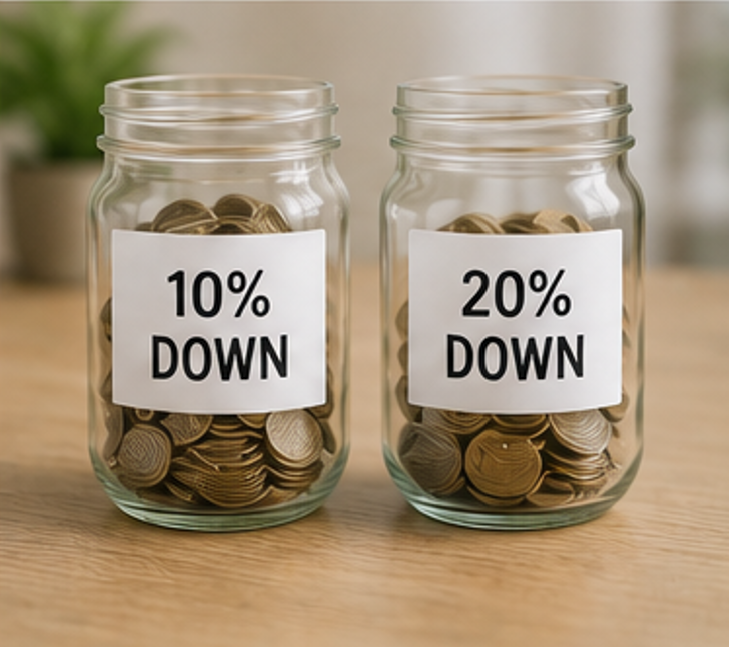
DOWN PAYMENT STRATEGY
10% vs. 20% Down: Which Makes More Sense?
Putting 20% down can lower the loan balance, reduce the payment, and potentially eliminate private mortgage insurance. But it also means committing more of your available cash to the home on day one.
The 20% Down Payment Isn’t a Rule
For generations of homebuyers, putting 20% down has been treated as a financial milestone.
Put 20% down, avoid mortgage insurance, borrow less, and lower your monthly payment. On the surface, it seems like the obvious choice.
And sometimes it is.
But a larger down payment also means putting more of your available cash into the house on day one. That money is no longer sitting in savings, available for improvements, emergencies, investments, or whatever comes next.
So the better question isn’t simply:
Can you put 20% down?
It’s:
What are you getting in exchange for putting that additional money into the home?
That is where the decision between 10% and 20% down becomes more interesting.
Start With a Simple Example
Imagine you’re purchasing a $500,000 home with a conventional mortgage.
SIDE-BY-SIDE EXAMPLE
Same Home. Two Down Payment Strategies.
$50,000 Down
Home price: $500,000
Starting loan: $450,000
Cash retained: Approximately $50,000 more than the 20% option, before considering other transaction costs.
$100,000 Down
Home price: $500,000
Starting loan: $400,000
Additional cash committed: $50,000
The difference is straightforward.
Putting 20% down requires another $50,000 at closing and reduces the starting mortgage balance by the same amount.
The 20% option will generally produce a lower monthly principal-and-interest payment. It can also eliminate the need for private mortgage insurance on a conventional loan.
Those are real advantages.
But the 10% option leaves approximately $50,000 more of your money outside the house.
And that matters too.
What Does the Additional 10% Actually Buy You?
When comparing down payments, it helps to stop thinking about 20% as a target and start thinking about the additional 10% as an investment.
You are effectively deciding whether to move another $50,000 from your available cash into your home equity.
What do you receive in return?
THE TRADEOFF
What the Additional Cash Can Potentially Change
Loan Balance
A larger down payment creates a smaller starting mortgage.
Monthly Payment
Borrowing less generally lowers principal and interest.
Loan Pricing
Pricing may differ depending on the loan-to-value and complete scenario.
Mortgage Insurance
Reaching 20% down can eliminate the need for PMI on a conventional loan.
Those benefits can absolutely justify the additional cash.
But their value should be compared with what you give up by making the larger down payment.
Mortgage Insurance Deserves Context
One of the biggest reasons buyers try to reach 20% down is to avoid private mortgage insurance, commonly called PMI.
That makes sense. Nobody particularly enjoys paying an additional monthly expense.
But avoiding PMI should not automatically determine the entire financing strategy.
PMI on a conventional mortgage can vary considerably based on factors including credit profile, loan-to-value ratio, loan structure, occupancy, and other underwriting characteristics.
That means the right comparison isn’t:
PMI vs. no PMI.
It is:
How much does PMI actually cost in this particular scenario, and how much additional cash would I have to contribute to eliminate it?
Those are very different questions.
Suppose reaching 20% requires another $50,000 at closing.
If the mortgage insurance associated with the 10% down option is relatively modest, a buyer may decide that keeping some or all of that $50,000 available is more valuable than eliminating the monthly PMI immediately.
Another buyer may look at the same numbers and prefer the guaranteed monthly savings and lower debt that come with putting 20% down.
Neither decision is inherently wrong.
The numbers—and the buyer’s priorities—determine the answer.
EQUITY IS NOT LIQUIDITY
Having More Equity and Having More Cash Available Are Not the Same Thing.
A larger down payment can strengthen the equity position and lower the mortgage. A smaller down payment can preserve more cash for reserves, improvements, emergencies, investments, and whatever comes after closing.
Your Monthly Payment Is Only Part of the Decision
Putting more money down generally reduces the monthly mortgage payment.
But a mortgage decision shouldn’t be evaluated solely by asking which option creates the lowest payment.
Consider what happens to your overall financial position after closing.
If putting 20% down leaves you with substantial reserves, the larger down payment may be perfectly comfortable.
But what if reaching 20% means using nearly all of your available cash?
You may own more equity, but you could also enter homeownership with very little liquidity.
And houses have a habit of introducing expenses shortly after someone gets the keys.
Furniture. Moving costs. Repairs. Appliances. Landscaping. Improvements. Property-tax adjustments. Insurance changes.
And occasionally something expensive that nobody planned for.
Having equity in a house and having cash available are not the same thing.
Cash Reserves Have Value
Imagine two buyers purchase identical $500,000 homes.
AFTER CLOSING
Two Buyers. Two Different Balance Sheets.
$100,000 Down
Savings retained: $20,000
Smaller mortgage and more immediate home equity, but less cash remaining outside the property.
$50,000 Down
Savings retained: $70,000
Larger mortgage, but considerably more liquidity remaining after the purchase.
Which buyer is in the stronger financial position?
There isn’t enough information to answer that question.
We would want to know about their income stability, other debts, emergency reserves, upcoming expenses, investment goals, comfort with monthly payments, expected time in the property, and several other factors.
That is precisely the point.
Down payment percentage alone does not tell you whether a mortgage strategy is good.
There Is Also an Opportunity Cost
Money used for a down payment has a very specific job: it becomes equity in the property.
That can be a perfectly good use of capital.
But capital can have other jobs too.
A buyer might keep additional funds available for emergency reserves.
They might pay off higher-cost debt.
They might renovate the property.
They might maintain investments rather than liquidating them.
An investor might preserve capital for another property.
A business owner may place an especially high value on liquidity.
None of those alternatives automatically makes a smaller down payment better.
They simply demonstrate why the decision should be evaluated in the context of the buyer’s entire financial picture.
The question becomes:
Where does the next dollar create the most value for you?
The Interest Rate Can Complicate the Comparison
There is another reason not to assume that down payment percentages exist in isolation: mortgage pricing can change with the structure of the loan.
Interest rates and pricing can be influenced by several factors, including credit profile, occupancy, property type, loan amount, loan-to-value ratio, points or lender credits, and market conditions.
So comparing 10% and 20% down using the exact same assumed interest rate may not always reflect the actual choices available to a borrower.
The proper comparison uses the real financing options available at the time.
COMPARE THE COMPLETE STRUCTURE
Don't Compare the Down Payment in Isolation.
Cash to Close
How much money does each structure require upfront?
Rate & Costs
How do interest rate, points, credits, and closing costs differ?
Monthly Cost
Compare loan amount, principal and interest, and mortgage insurance.
Cash Remaining
How much money remains available after the transaction closes?
Only then can you meaningfully compare the two strategies.
How Long You Expect to Own the Home Matters Too
Mortgage decisions take place over time.
Suppose putting additional money down saves a certain amount every month.
If you expect to own the property for many years, those monthly savings have more time to accumulate.
If you expect to move again relatively soon, the analysis may look different.
The same principle applies to paying discount points, refinancing, choosing loan terms, and many other mortgage decisions.
A financing strategy that makes sense over ten years may not make sense over three.
Your expected time horizon deserves a place in the decision.
When 20% Down May Make More Sense
A 20% down payment can be particularly attractive when the additional cash contribution still leaves you with comfortable reserves.
It may also make sense when eliminating mortgage insurance creates meaningful savings, when the resulting payment better fits your monthly budget, or when your priority is simply minimizing debt.
Some buyers value the certainty of having a smaller mortgage more than maintaining additional liquidity.
There is nothing wrong with that.
Financial decisions are not made on spreadsheets alone. A strategy also needs to fit the person using it.
When 10% Down May Make More Sense
Putting 10% down can deserve serious consideration when reaching 20% would significantly reduce your available cash.
It may also be attractive when mortgage insurance is relatively inexpensive, when maintaining reserves is important, or when you have another productive use for the additional funds.
For some buyers, the flexibility created by keeping additional cash available outweighs the benefit of immediately minimizing the mortgage balance.
Again, the goal isn't to prove that 10% is better.
It is to understand what you are buying with the additional 10%.
The Golden Oak Perspective
The traditional mortgage conversation often begins with a product:
30-year fixed.
15-year fixed.
FHA.
Conventional.
Jumbo.
We think the better conversation begins with the decision.
What are you trying to accomplish?
If you're deciding between 10% and 20% down, we don't think the answer should come from a rule of thumb.
We want to see both scenarios.
How much cash does each require?
What happens to the monthly payment?
What happens to mortgage insurance?
How much money remains available after closing?
And most importantly:
Which structure puts you in the position you actually want to be in after you buy the home?
Sometimes the answer will be 20%.
Sometimes it may be 10%.
And sometimes, after seeing the numbers, a completely different down payment makes more sense.
That is mortgage planning.
PUT YOUR NUMBERS TO WORK
Compare Down Payments Side by Side.
Use the Golden Oak Mortgage Calculator to explore how changing your home price and down payment affects your estimated loan amount and monthly payment.
Open the Mortgage Payment CalculatorThen compare the scenarios side by side.
The goal isn't to find the down payment percentage everyone else uses.
It's to find the financing structure that makes sense for what you're trying to accomplish.
READY TO COMPARE?
See What 10%, 20%, or Something In Between Actually Looks Like.
Compare cash to close, loan amount, estimated payment, mortgage insurance, and cash remaining after closing before deciding how much to put down.
This article is provided for general educational and informational purposes only and is not financial, legal, tax, or investment advice or a commitment to lend. Examples are illustrative and do not represent a loan offer or guarantee of available terms. Mortgage insurance, interest rates, pricing, closing costs, eligibility requirements, and loan programs vary based on borrower qualifications, property characteristics, market conditions, lender requirements, and other factors. All loans are subject to application, underwriting, credit approval, property review, lender requirements, and program availability.